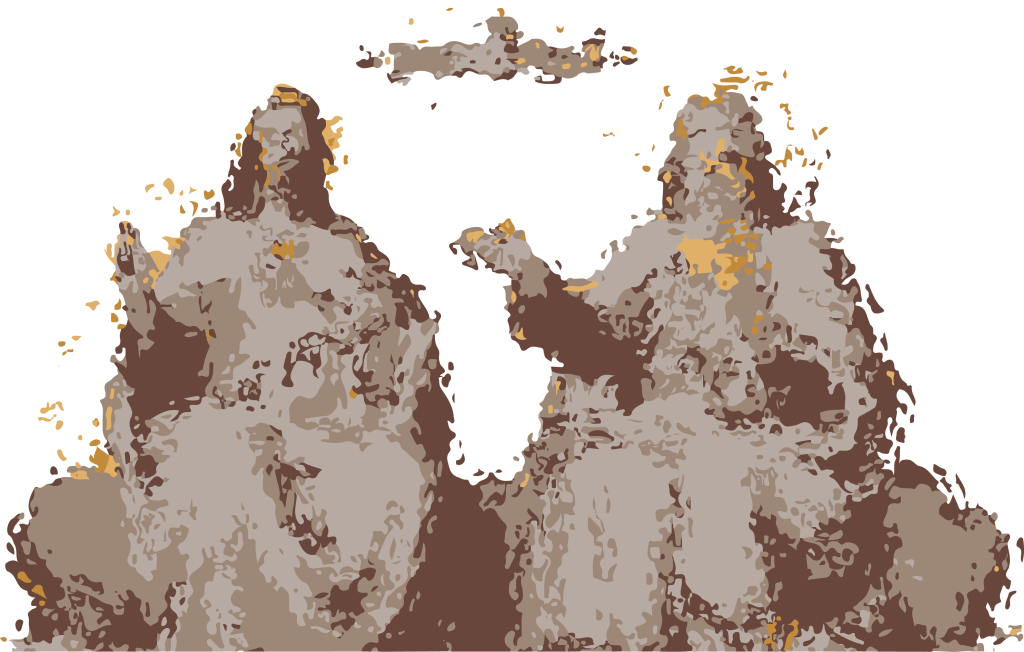
One day, the gods withdraw. Of their own volition, they withdraw their divinity, which is to say, their presence. They won’t simply leave, they won’t go somewhere else, they’ll withdraw their own presence — they’ll disappear within it.
Kenosis is in origin a theological concept, it denotes the moment when Jesus empties himself of his divinity to be reborn in the likes of man. The word translates to emptying, but it is not clear within the text of what Jesus had emptied himself. This remains the question for theologians. There are a lot of answers to this question, but most theologians seem to agree that the specific answer that Jesus emptied himself of all his divinity is reading too much into the scripture. But it is precisely this “wrong” answer that gives us an interesting concept, a movement that has a self-preserving element to it within its disavowal of itself.
Nancy in his work Dis-enclosure describes kenosis as:
…a word consecrated (the term is apposite here) by Paul in his theological usage (God emptying himself of his divinity in Jesus Christ). By declaring his intent to assign this term to ‘‘an ontological index that is no longer theological.
The kenotic quality of this logic is its ability to empty itself while perpetuating its own boundaries, it’s a self-preserving logic. The death of God merely meant the self-emptying of Christianity into secular modernity for Nancy, not the negation of Christianity itself. This emptying implies that the husk that is emptied remains, this husk is an ontological index of which Christianity is merely one of its modes.
God may be dead, but its altars remain.
The Christian logic has this quality of deterritorializing and reterritorializing its content in order to retain its form. For example, Capitalism can be seen as a mode of the Christian logic, where the metaphorical original sin, the thing that made us born with a debt into the world, has emptied itself and restructured itself into not a metaphorical debt but a physical debt to the system of Capitalism.
According to Walter Benjamin in his work Capitalism as Religion, Capitalism serves to perpetuate the same anxieties and torments that Religion perpetuated and claimed to have solutions for. Capitalism is essentially religiously structured, a divine religion become flesh through the logic of kenosis. Benjamin says:
Capitalism is entirely without precedent, in that it is a religion which offers not the reform of existence but its complete destruction. It is the expansion of despair, until despair becomes a religious state of the world in the hope that this will lead to salvation. God’s transcendence is at an end. But he is not dead; he has been incorporated into human existence.
The metaphysical God is dead, long live the salvation that lives within us.
This is what is the dangerous mechanic of kenosis, we can’t just negate or kill systems that show themselves to be oppressive or exploitative. When we cut off the head of such a system, it empties itself of its content, and often it leaks through into other structures. The disavowal of slavery resulted in many laws like redlining that retained its racist logic, we can not simply see these laws as the remains of slavery, it is far more pervasive than that. White supremacy has restructured itself in a way where it is not outspokenly racist (although it of course still is at certain occasions) but where its racism is embedded in, among many things: laws, socioeconomics, schools, access to healthcare and infrastructure.
Bibliography
Nancy, Jean-Luc. Expectation: Philosophy, Literature. Fordham University Press, 2017.
Nancy, Jean-Luc, en Michael B. Smith. Dis-Enclosure: The Deconstruction of Christianity. Fordham Univ Press, 2009.
Benjamin, Walter. Capitalism as religion. 1921.
 BENJAMIN BAS
Plaats een reactie