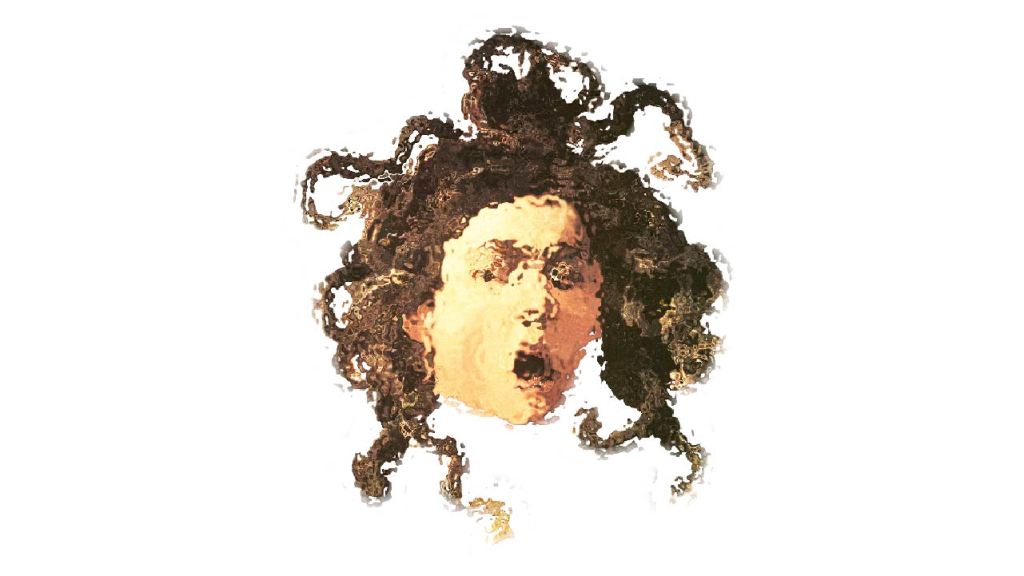
Cixous in her work The laugh of the Medusa discusses the concept of feminine writing. I want to explore this idea and how it relates to her use of the concept of flight and the Medusa myth. I will use a lot of quotes, as to let Cixous’ language speak itself. But first, it is necessary to refresh ourselves with the myth of the Medusa.
Medusa possessed an astonishing beauty, her name means guardian or protectress. There are two readings of the myth, one where Athena refused Medusa to move to another place in fear of the people worshipping Medusa instead of her for her beauty.
The other, more sinister one, Medusa came into conflict with Athena because she was raped by Poseidon and in order to punish her for being raped she changed Medusa’s hair into snakes. Seeing herself transformed into such a hideous creature, she fled from her home to Africa. The curse of Athena turned into stone whoever Medusa gazed upon, till at least after a life of misery she was killed by Perseus.
Perseus, helped by Athena, comes searching for Medusa. Athena has given him a shield through which he can look at Medusa without getting turned into stone. Then, when Medusa was helplessly asleep, Perseus struck and chopped off her head. The blood that flowed out of her neck gave birth to two winged creatures, the Pegasus, and the Chrysaor.
That’s the myth that Cixous wants to engage with.
Throughout the centuries, the place for women in writing has proven to be a hard place to open up, just like any other place for women in society. The field is not only male-dominated, but its rules are also masculine. Logo-centrism and phallocentrism are extensions of each other, the history of writing has been confounded by the history of reason, you can not separate the two in Western culture as they are the same. When women try to breach this field of writing, they are forced to write according to the rules that man had laid out, your thought must be heard. That is the only thing that counts, your logic.
Within this masculine writing, there is an anxiety, an obsession to know how things work in order to make them work. For Cixous, it is important that your body must be heard. Under the patriarchal structure, woman has always functioned within the discourse of men, only allowed to exist within the male logic and grammar. A logic that totally disregards the body. This is why Cixous calls for an explosion from this within, dislocating it and seizing it through a feminine writing. Woman must write woman to invent herself a language to get inside of. Somewhere else, Cixous says:
I am religiously atheistic but literally deistic, that is ultimately no one can write without the aid of God, but then what is God without the aid of writing?
Women must write themselves and bring women to writing from which they have been violently driven away as violently as from their bodies for the same reasons, by the same law, with the same fatal goal. Woman must put herself into the text, as into the world, as into history by her own movement by writing.
The point here is not to simply appropriate the instruments of male writing or logic. The woman must write herself and make her body be heard.
To write. An act which will not only “realize” the decensored relation of woman to her sexuality, to her womanly being, giving her access to her native strength; it will give her back her goods, her pleasures, her organs, her immense bodily territories which have been kept under seal; it will tear her away from the superegoized structure in which she has always occupied the place reserved for the guilty (guilty of everything, guilty at every turn: for having desires, for not having any; for being frigid, for being “too hot”; for not being both at once; for being too motherly and not enough; for having children and for not having any; for nursing and for not nursing … )-tear her away by means of this research, this job of analysis and illumination, this emancipation of the marvelous text of her self that she must urgently learn to speak. A woman without a body, dumb, blind, can’t possibly be a good fighter. She is reduced to being the servant of the militant male, his shadow. We must kill the false woman who is preventing the live one from breathing. Inscribe the breath of the whole woman.
For Cixous the point is not to take possession in order to internalize and manipulate, but rather to dash through and fly.
Flying is woman’s gesture-flying in language and making it fly. We have all learned the art of flying and its numerous techniques; for centuries we’ve been able to possess anything only by flying; we’ve lived in flight, stealing away, finding, when desired, narrow passageways, hidden crossovers. It’s no accident that voler has a double meaning, that it plays on each of them and thus throws off the agents of sense. It’s no accident: women take after birds and robbers just as robbers take after women and birds. They (illes) go by, fly the coop, take pleasure in jumbling the order of space, in disorienting it, in changing around the furniture, dislocating things and values, breaking them all up, emptying structures, and turning propriety upside down.
What woman hasn’t flown/stolen? Who hasn’t felt, dreamt, performed the gesture that jams sociality? Who hasn’t crumbled, held up to ridicule, the bar of separation? Who hasn’t inscribed with her body the differential, punctured the system of couples and opposition? Who, by some act of transgression, hasn’t overthrown successiveness, connection, the wall of circumfusion?
Lets get back now to the myth we began with, we must write over the Medusa myth. Before Medusa was this protectress and after she was too horrid to be perceived, write over this. Men have a need to link femininity to death as they need to be afraid of femininity, it’s the jitters that gives them a hard-on!
Look at the trembling Perseuses moving backward toward us, clad in apotropes. What lovely backs! Not another minute to lose. Let’s get out of here.
Protections, walls build around him, he doesn’t dare look at the world through any other ways than his shield, his alibi of logo centrism.
Cixous wants to write Medusa’s body, her intact body before the decapitation. It is a song this writing of the body, something with rhythm and no words, it is written in white ink not immediately visible unless you know what to look for. It is not a mere representational logical language, it is flow, vibration, resonance.
You only have to look at the Medusa straight on to see her
Don’t look at the reflection of your shield
look at her straight on
she is not deadly, she is beautiful and she is laughing.
Bibliography
Cixous, H. (c. 1976). Laugh of the Medusa.
Cixous, H. (1991). “Coming to Writing” and other essays. Harvard University Press.
The Philosophical Research Society. (2018, 7 september). Hélène Cixous: The Laugh of the Medusa [Video]. YouTube. https://www.youtube.com/watch?v=5GWD95Omy4s
 BENJAMIN BAS
Plaats een reactie